Helen calls for reversal of confirmed cuts to ‘world-leading’ telescope network
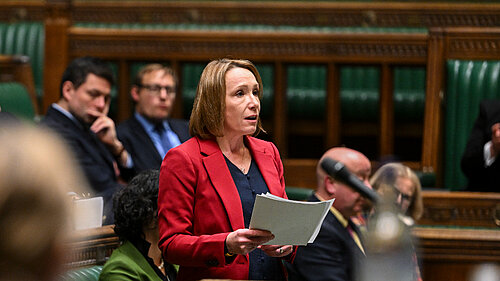
Helen Morgan MP has said she is ‘greatly dismayed’ by confirmation that funding for a radio telescope network will end and has called for the decision to be reversed.
Helen has written to the Government warning that the decision to cut funding for the e-MERLIN project could lead to the closure of the telescope at Knockin, and severely impact Jodrell Bank observatory, which runs the network.
The telescope at Knockin links North Shropshire to the world-leading e-MERLIN scientific research programme, led by the University of Manchester from the internationally renowned Jodrell Bank.
The e-MERLIN programme consists of seven radio telescopes across England, which come together to give world-leading insight into the universe and play a practical role in space defence.
Helen’s intervention follows the announcement by the Science and Technology Facilities Council (STFC) that funding for e-MERLIN will not continue beyond March 2028, raising concerns among scientists and researchers about the future of Jodrell Bank, one of the UK's most important astronomy facilities.
In June, Helen warned that proposed science funding cuts could put the 25-metre radio telescope at Knockin at risk. Now confirmed, she has written to the Secretary of State for Business, Innovation, Science and Trade, Jonathan Reynolds MP, urging him to “explore all possible options” to reverse the decision.
In the letter, Helen outlines how the “world-leading research network, once lost, cannot be rebuilt” and highlights the local impact that closure of the network would have on North Shropshire.
Although the Knockin site is remotely operated, potential job losses from across the area could include many which serve the telescope’s operations.
Helen Morgan, MP for North Shropshire, said: “I am deeply concerned by the decision to end funding for e-MERLIN and the consequences this could have for both the telescope at Knockin and the wider Jodrell Bank Observatory.
“The telescope at Knockin is part of a globally respected network supporting research into our universe. It also connects North Shropshire to a scientific endeavour of international importance.
“Scientists have been clear that these cuts risk causing lasting damage to Britain's research capability and could undermine our position as a world leader in astronomy and space science.
“That is why I have urged ministers to explore every possible option to reverse this decision and protect this invaluable scientific and national asset.”
In her letter, Helen cited concerns raised with her by Dr Jack Radcliffe, a Jodrell Bank research scientist from Whitchurch, who said the observatory had inspired him to pursue a career in astrophysics.
She also highlighted warnings from leading scientists, including Scotland's Astronomer Royal, Professor Catherine Heymans, who described the potential loss of Jodrell Bank as an “act of national self-harm”, and Professor Michael Kramer, Director of the Max Planck Institute for Radio Astronomy, who called the decision “scientifically, technologically and economically short-sighted”.
Helen also pointed to the wider economic and strategic importance of the e-MERLIN network, including its role in supporting thousands of researchers and contributing to the observation of satellites and space debris.
The University of Manchester has reported on the technological importance of the project, which enables sharing of radar detections across government, defence and industry in both the UK and Australia.
In the letter, Helen continues: “The observation of satellites and space debris enabled by e-Merlin should be playing an ever more crucial role, as scientists continue to report on the rising risk of a build-up of space debris, not least following recent reports of a SpaceX rocket crashing into the Moon.”
Helen warned that closure of the network would damage the UK's international scientific reputation and weaken a facility that has long been regarded as one of the country's most significant contributions to global astronomy.