Science funding cuts could threaten North Shropshire telescope, warns Helen

Helen Morgan MP has raised concerns over proposed cuts to national science funding, warning they could put vital research infrastructure at risk including a radio telescope at Knockin.
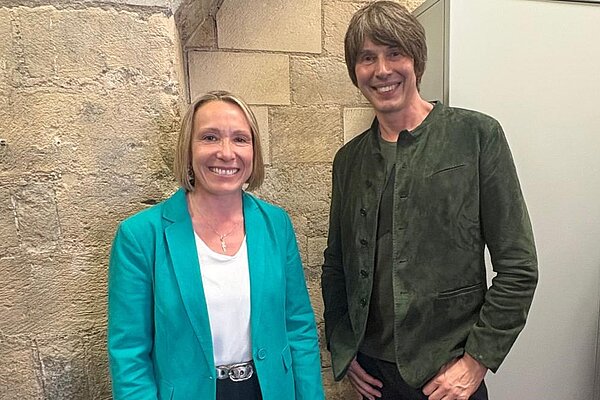
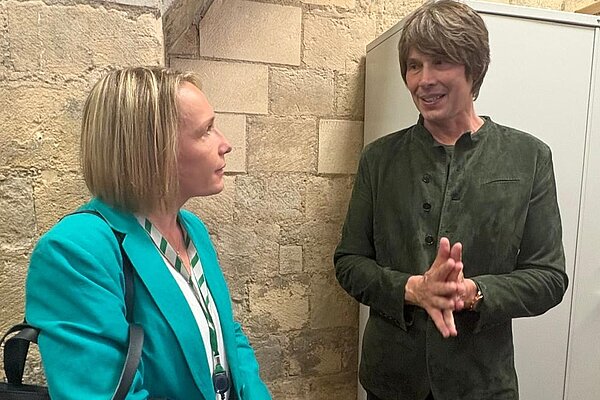
Helen heard of the growing alarm across the scientific community when she met leading physicist Professor Brian Cox in Parliament on Monday (15th June).
The cuts, proposed by the Science and Technology Facilities Council (STFC), are expected to reduce funding across particle physics, astronomy and nuclear physics by up to 30% or more, raising fears about the long-term sustainability of UK research and innovation.
The 25-metre radio telescope at Knockin forms a key part of e‑MERLIN (Enhanced Multi-Element Radio Linked Interferometer Network) - a globally significant array of seven radio telescopes sited across the UK.
Operated by the University of Manchester on behalf of the STFC, e‑MERLIN links telescopes to combine their signals to act as a single, powerful array, enabling astronomers to produce ultra‑high‑resolution images of the universe, supporting cutting-edge research into black holes, galaxy formation, dark matter and cosmic events.
Helen has previously written to the Secretary of State for Science, Innovation and Technology highlighting the damage these cuts could cause to both local expertise and the UK’s global scientific standing.
Helen Morgan, MP for North Shropshire, said: “Science, innovation and technology are central to our economic growth and our place in the world. The UK has long been a global leader in astrophysics and discovery science, but that status is now under threat.
“I have heard directly from astronomers and from the Shropshire Astronomical Society about the devastating impact these cuts could have. Facilities like the telescope at Knockin are part of world‑leading research networks, which once lost, boast a capability that cannot be rebuilt.
“These proposals risk hollowing out the future of British science by driving away the very researchers we should be supporting - particularly early-career scientists.
“At a time when we face major global challenges and fierce international competition, this is precisely the wrong moment to cut investment in discovery science.”
The proposed reductions are expected to hit post-graduate researchers hardest, with the potential for drastic cuts to in funding for postdoctoral positions, driving talent oversees.
Speaking with MPs at Parliament, Professor Cox warned that the STFC faces around £162 million in annual savings, with cuts of roughly 30% to particle physics, astronomy and nuclear physics research.
Helen heard how the reductions were already having a severe impact on research, with postdoctoral positions effectively capped at their lowest levels since 2008.
Scientists warn that this could result in the loss of an entire generation of researchers, severely damaging the UK’s long-term innovation capacity and its position as a global leader in fields such as astrophysics and particle physics.
Helen is now calling on the Government to urgently clarify future funding plans and to work with the scientific community to safeguard the UK’s research base.
Helen added: “We cannot afford to undermine the pipeline of talent or weaken the position of research infrastructure such as the Knockin telescope, which is important on both a national and global stage.”