'I’m with her on this one' – PM commits to Helen's call to save telescope
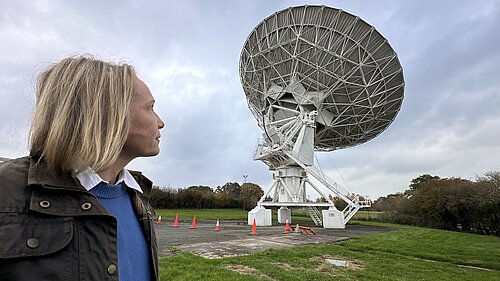
North Shropshire MP, Helen Morgan, has been told “a solution will be found” by the Prime Minister after she challenged him to prevent the closure of a world-leading telescope network.
Helen told Andy Burnham at Prime Minister’s Questions on Wednesday (18th November) that the UK was in danger of losing “sovereign capability” if the telescope at Knockin and the world-renowned Lovell telescope were mothballed.
Helen said it would be “reckless vandalism” for the e-MERLIN programme to cease if proposals to end funding next year were carried out.
Responding, the Prime Minister said he felt “duty-bound” to help and confirmed he would ensure a solution was found to save the infrastructure.
In putting her question to him, Helen said she had recently visited Jodrell Bank to learn more about the network and the UK’s national radio astronomy capabilities.
The 25-metre Knockin telescope has been a feature of the North Shropshire countryside for nearly half a century and was the first telescope to be included in the e-MERLIN array, which links dishes across the country including Cambridgeshire, Worcestershire and Cheshire, and has its headquarters at Jodrell Bank.
Operated by the University of Manchester, signals from the telescopes are combined with those from the huge Lovell telescope to produce exceptionally detailed images of the universe. Its work supports internationally important astronomical research, as well as providing valuable capabilities for monitoring satellites and space debris.
Putting her question to the Prime Minister, Helen highlighted the Knockin telescope’s role in the programme, adding: “Sovereign capability in radio astronomy is critical for the UK scientific community and for national security through its tracking and observatory capabilities. Once they are lost, they will be lost forever.
“The network is set to lose its funding in 2028. It would be reckless to lose this capability in an increasingly uncertain world, and vandalism to allow the Lovell Telescope to fall into disrepair.
“So will the Prime Minister commit to finding the money to save it?”
It is thought that in order to continue beyond 2028 the e-MERLIN programme would need around £2.8m in funding.
The Prime Minister has previously signalled his support for the programme and acknowledged its world-leading role.
In response across the despatch box this week, the PM said: “As part of a generation of northwest schoolchildren who went on trips to Jodrell Bank, I feel duty bound to do everything within my power to save that critical infrastructure, also a part of the heritage of this country.
“I am with her on this one. We do need to find a solution, and I will ensure one is found.”
Helen has previously argued that losing Knockin and the other telescopes in the array would mean losing sovereign capabilities in radio observation, which would affect the UK’s international standing in science, scientific and defence capabilities, and impact national security.
It’s estimated that there are currently more than 20,000 satellites in space, with that figure expected to increase to more than five times that amount in just the next five years.
The biggest operator of those currently orbiting the earth is Elon Musk’s SpaceX, which owns around two-thirds – with plans to increase the number to 100,000.
Speaking outside the Commons, Helen Morgan, MP for North Shropshire, said: “I’m pleased the Prime Minister has made a commitment to finding a solution that will protect the future of the Knockin telescope and the network of others that make up the array.
“This is about much more than simply scientific discovery. It’s about our capability for observing satellites and tracking space debris. As the number of objects in orbit increases, that capability will become ever more important to our national security and our ability to respond to emerging threats.
“We cannot afford to lose infrastructure like this.”
In June, Helen raised the threat posed by proposed science funding reductions after meeting leading physicist Professor Brian Cox in Parliament, subsequently writing to the Government warning that the cuts could undermine Britain's position as a world leader in astronomy and impact on opportunities for early career scientists.
Following confirmation in August that funding for e-MERLIN would end, Helen wrote to the Secretary of State for Business, Innovation, Science and Trade, Jonathan Reynolds MP, urging him to explore options to reverse the decision.
In her correspondence, she highlighted the concerns of scientists and researchers, including Dr Jack Radcliffe, a Jodrell Bank research scientist from Whitchurch, and warnings from leading figures in the international scientific community about the consequences of losing the network.